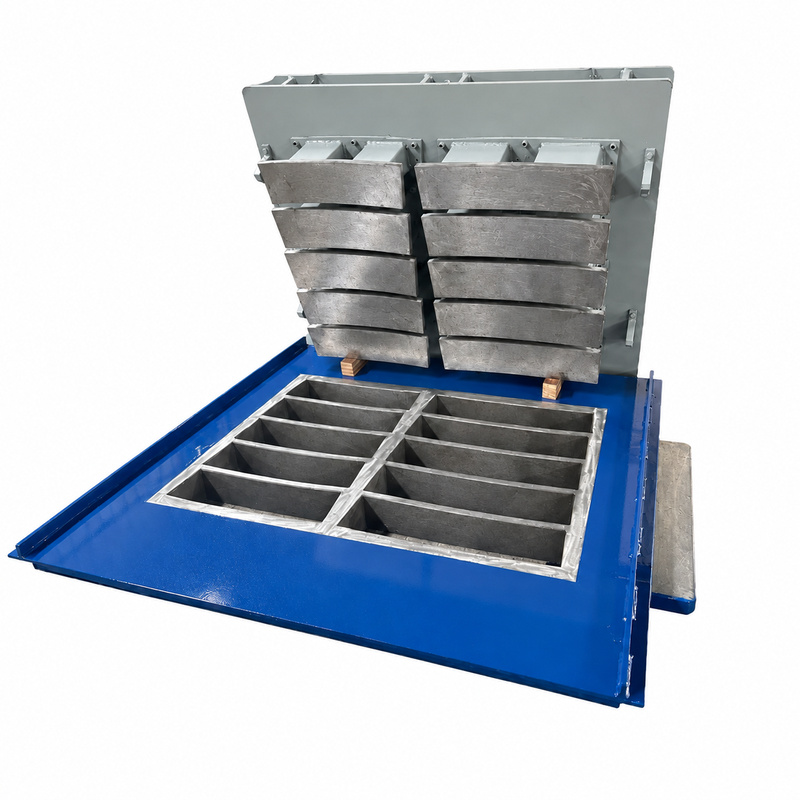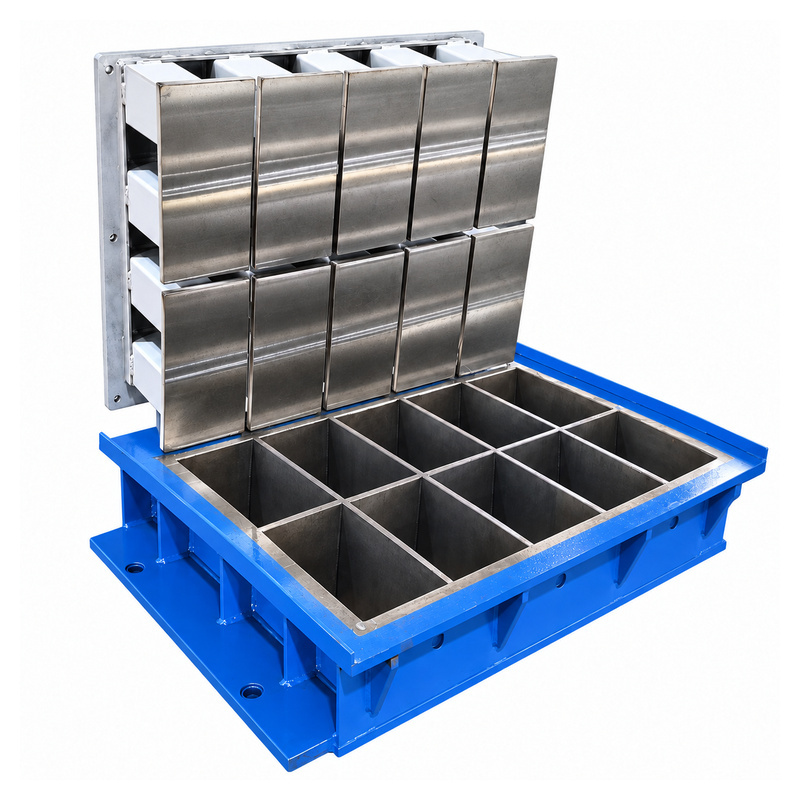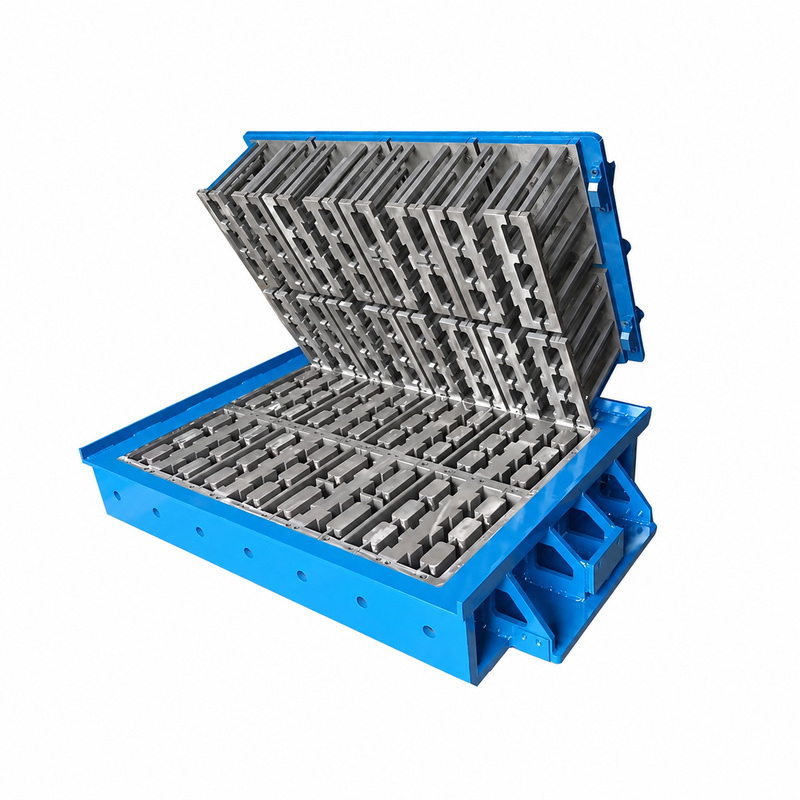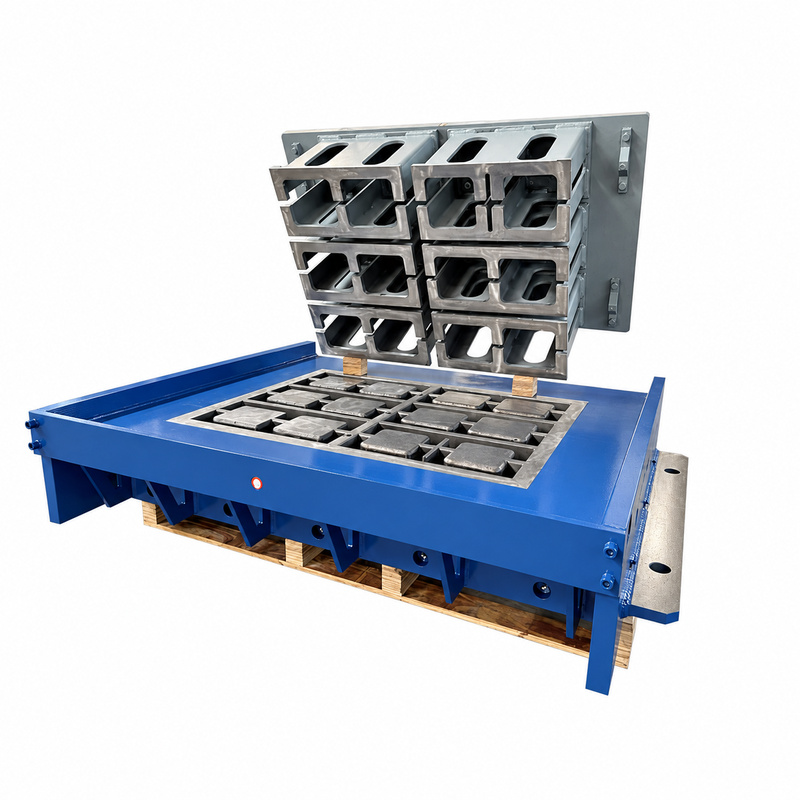
Concrete Block Molds
Hollow Block Mold
Solid Block Mold
Solid Brick Mold
Interlocking Block Mold
Thermal Block Mold
Edge damage can be associated with concrete consistency, product geometry, compaction, machine settings, demolding conditions, mold wear, or other production factors. If a customer experiences repeated edge damage, the complete production conditions should be checked rather than assuming that the mold is the only cause....
Complex profiles may contain more corners, edges, or detailed forming areas than conventional pavers. These areas should be inspected and cleaned regularly because concrete buildup or wear can affect the finished paver geometry....
We recommend providing: Machine brand and model Paver dimensions 2D or 3D drawing if available Photos or physical sample Required paver thickness Edge/chamfer requirements Existing mold information Any special surface or production requirements The more complete the information, the easier it is to confirm the mold design before manufacturing....
A grass paver mold is designed to produce concrete grid or grass paving blocks with open spaces that can allow grass growth or provide permeable areas. Compared with conventional solid pavers, grass pavers normally contain larger openings and a more complex internal geometry....
Yes. HAWEN can manufacture grass paver molds according to customer drawings, samples, or specified dimensions. The external shape, internal openings, ribs, and overall pattern can be customized according to the required grass paver design....
Yes. The number, size, shape, and arrangement of the openings can be customized. However, these features affect the remaining concrete sections of the paver, mold structure, filling, compaction, and demolding. Therefore, the complete block geometry should be evaluated before mold manufacturing....
Grass pavers often contain large openings and relatively narrow concrete ribs. This makes the geometry more demanding than a conventional square or rectangular paver. The mold must form the internal openings accurately while allowing the fresh concrete product to be released reliably during production....
Breakage can be related to several factors, including: Very thin block sections Block geometry Concrete mix consistency Moisture content Insufficient compaction Machine settings Demolding conditions Worn or unsuitable mold components For this reason, both the mold design and production parameters should be considered when troubleshooting breakage....
The manufacturing method depends on the specific geometry. HAWEN selects appropriate materials, machining methods, and heat-treatment processes according to the structure of the mold. For applicable components, precision machining and heat treatment are used to improve dimensional consistency and wear resistance....
Yes. A physical sample can be used as a design reference. For accurate mold development, we also recommend providing your block machine brand and model, existing mold information, and any available block drawings or dimensions....
HAWEN can manufacture customized molds for various interlocking paving geometries according to drawings, samples, dimensions, and production equipment....
Interlocking pavers use geometric profiles that interact with adjacent units. This makes profile accuracy and dimensional consistency particularly important for the finished pavement....
Yes. Customers can provide an existing design or their own block drawing. The proposed profile will be evaluated for mold manufacturing and production feasibility....
Yes. The target thickness is considered during mold design, subject to the production capabilities and settings of the block machine....
Material selection, machining accuracy, heat treatment, machine adjustment, and routine maintenance all contribute to controlling wear. Actual wear patterns vary according to paver geometry and production conditions....
This FAQ section answers the questions most often raised by buyers and engineers working with concrete block, paver, kerbstone, retaining-wall and special-shape moulds. It covers the practical topics that come up before and during a mould enquiry, from how a mould is matched to a block-making machine and a specific brick type, to the parameters that need to be confirmed before a design can be reviewed.
The content here serves producers, project engineers and procurement teams who need to check an interface, clarify a drawing or understand what information is required to move a mould request forward. Each answer explains the relevant brick type and its requirements rather than describing a specific customer project.
HAWEN helps by setting out the information needed to evaluate a mould application and by keeping unconfirmed parameters clearly marked as unconfirmed. Where a topic depends on details such as machine compatibility, tolerance or lead time, the answer states what must be supplied so the point can be checked properly.
 Tel: +8618359454595
 Email: sale@hwmachines.com
 MP/WhatsApp: +8618359454595
 Manufacturer Address:Nanan, Quanzhou City, Fujian Province, China